
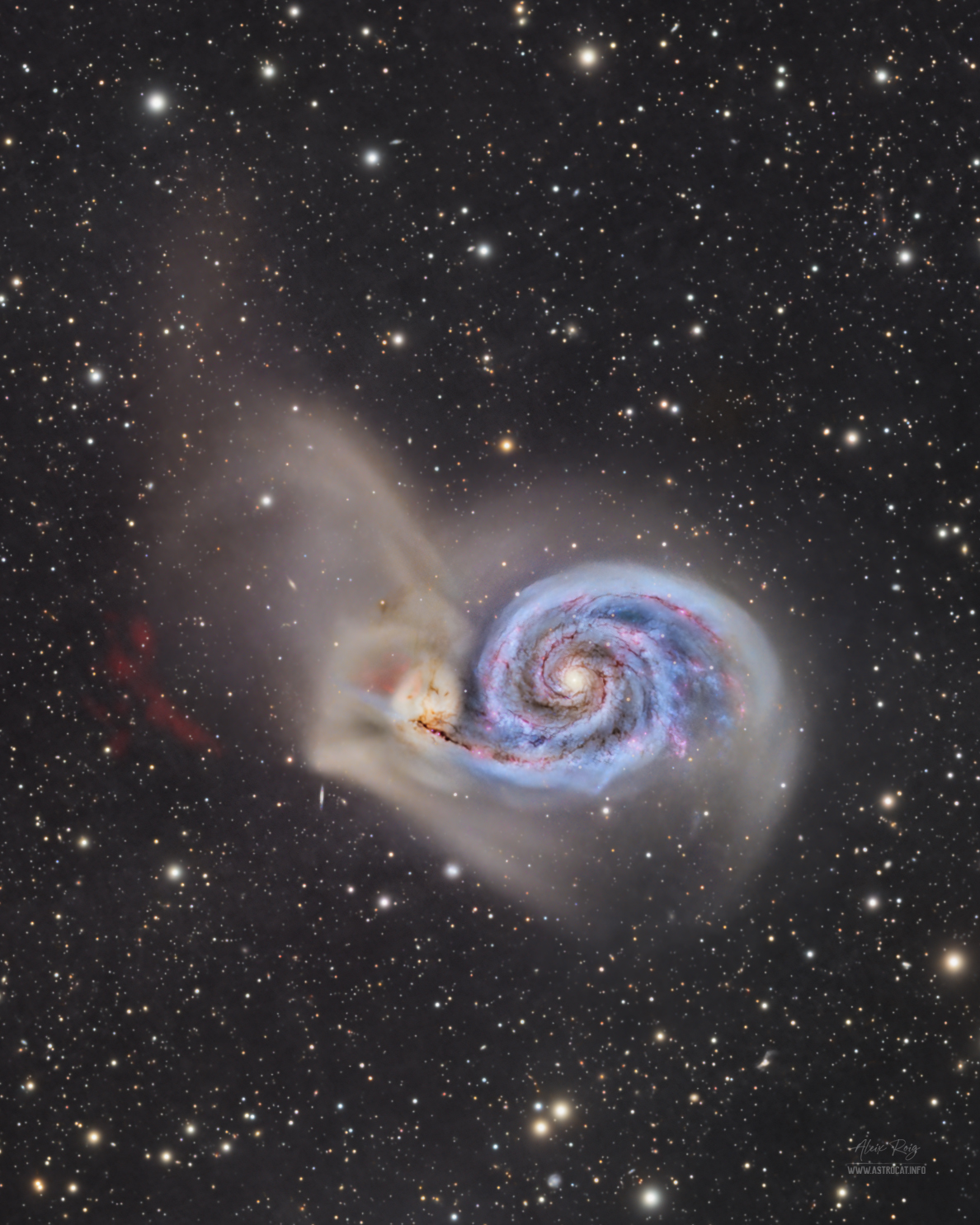
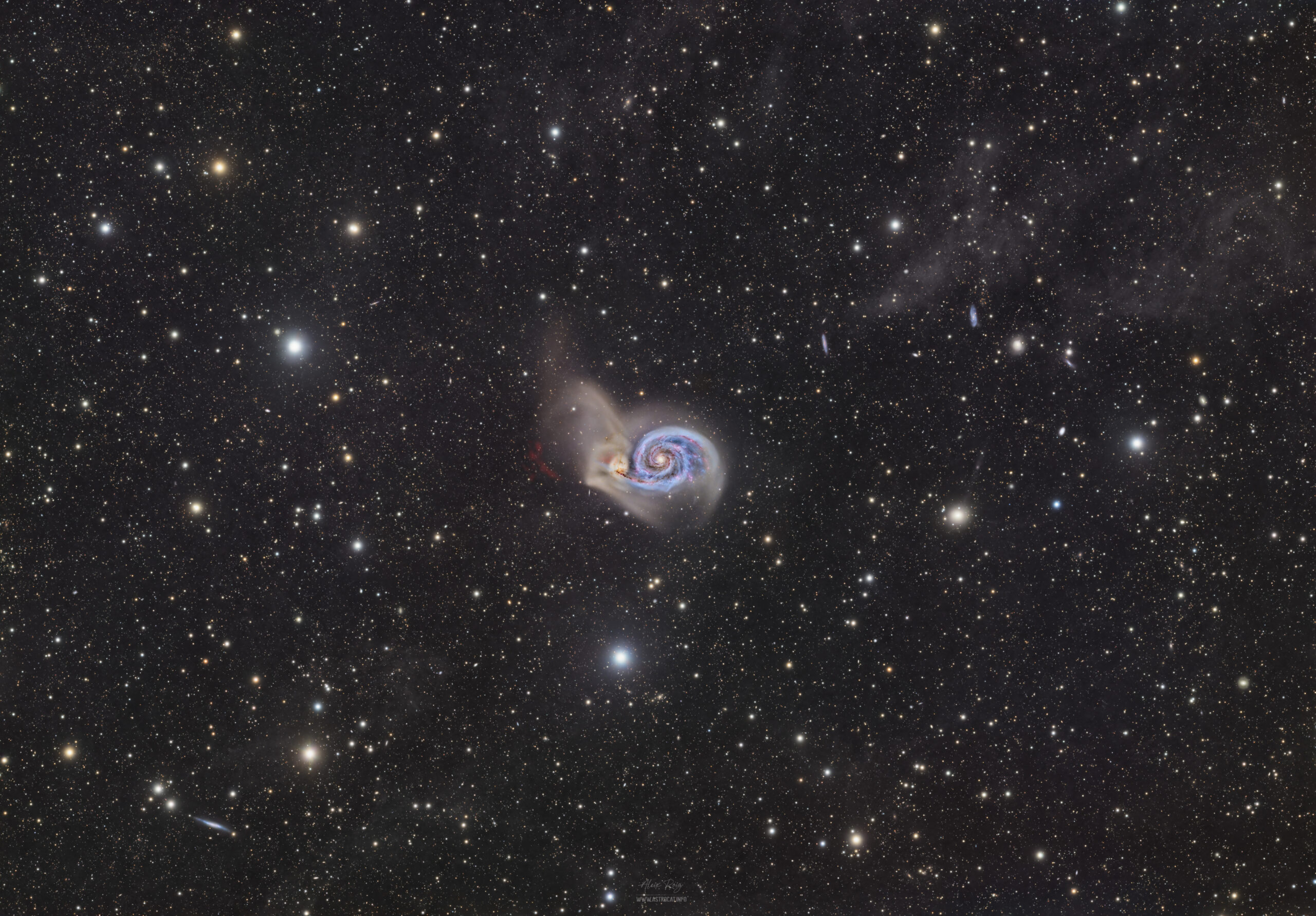
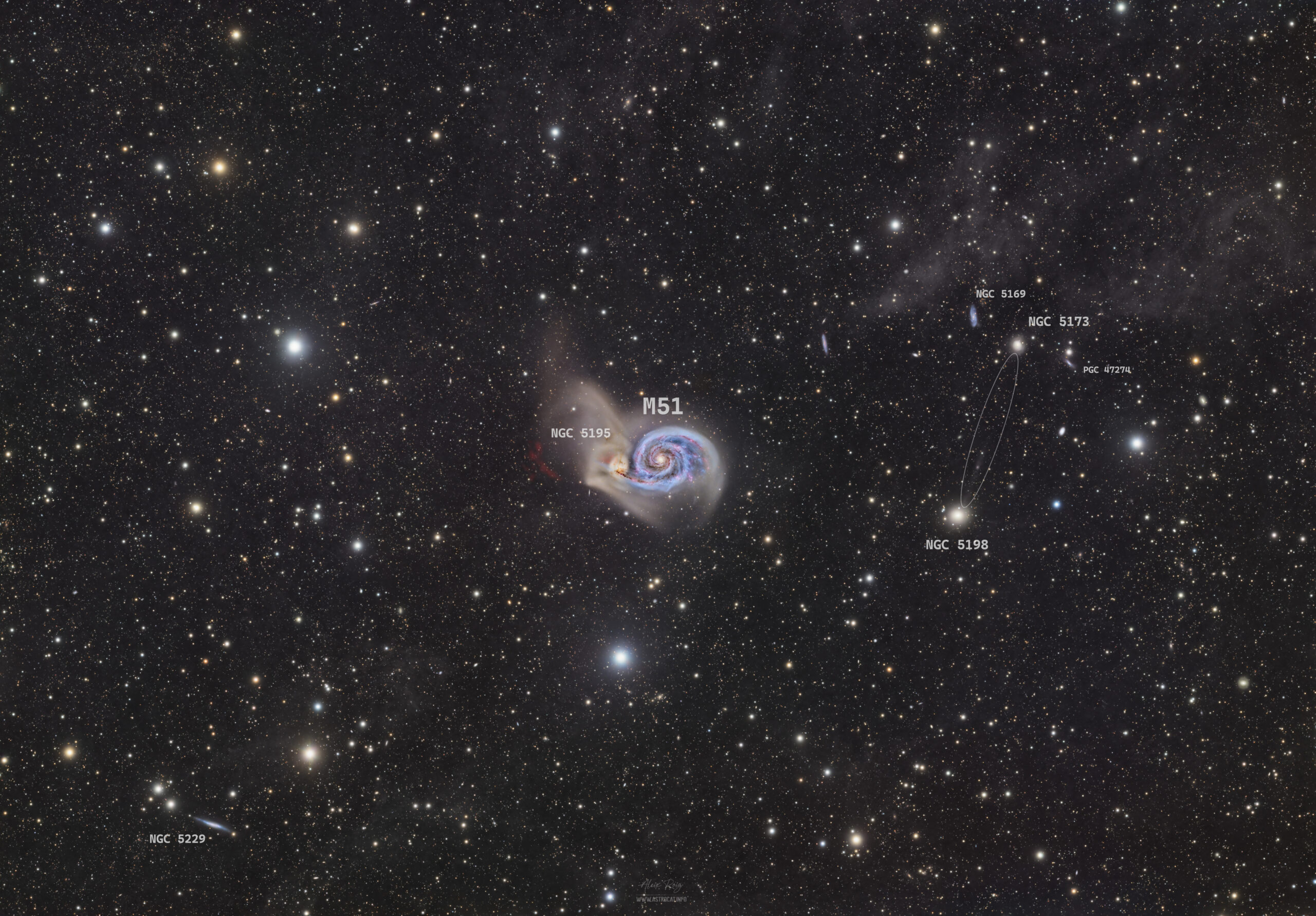
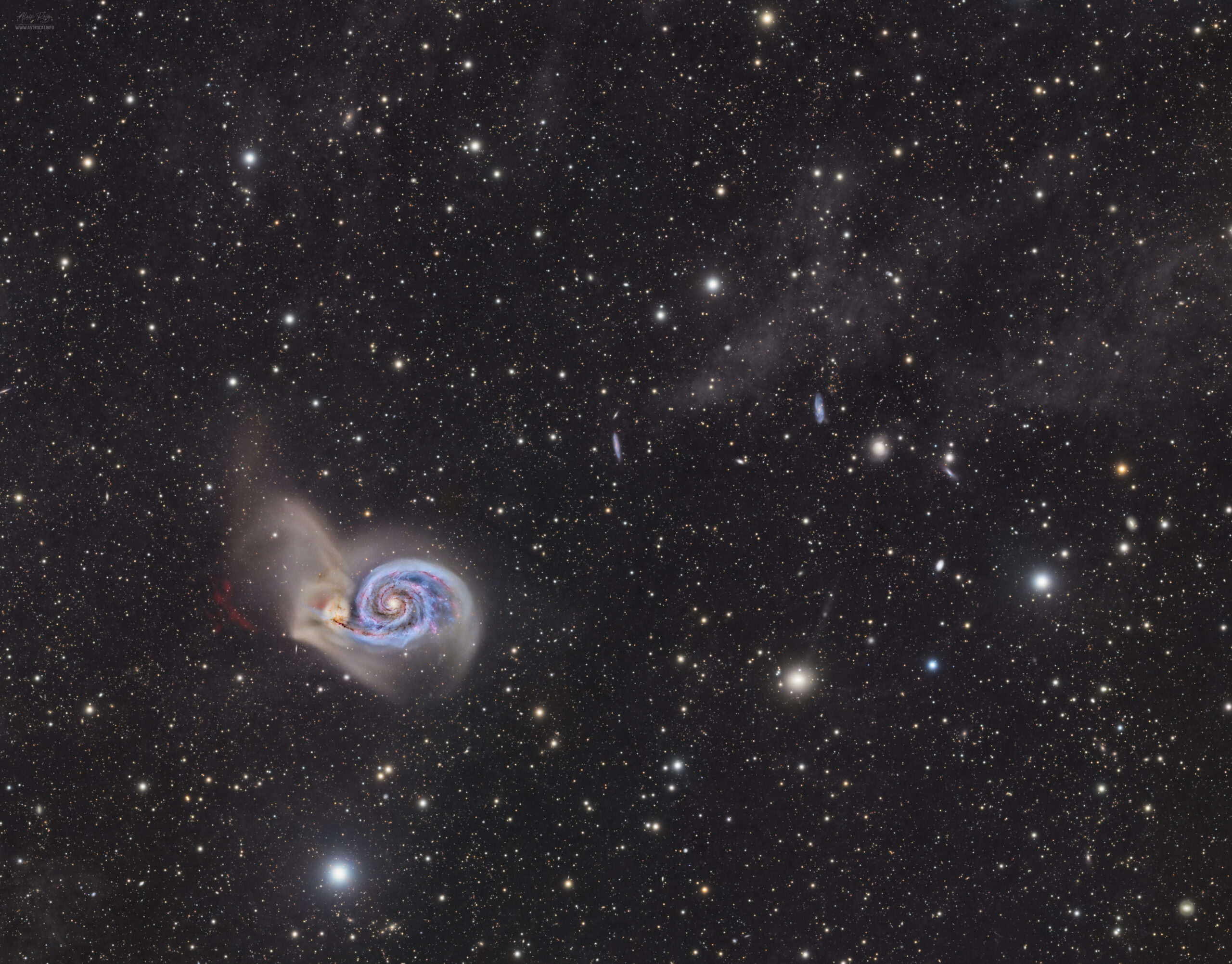
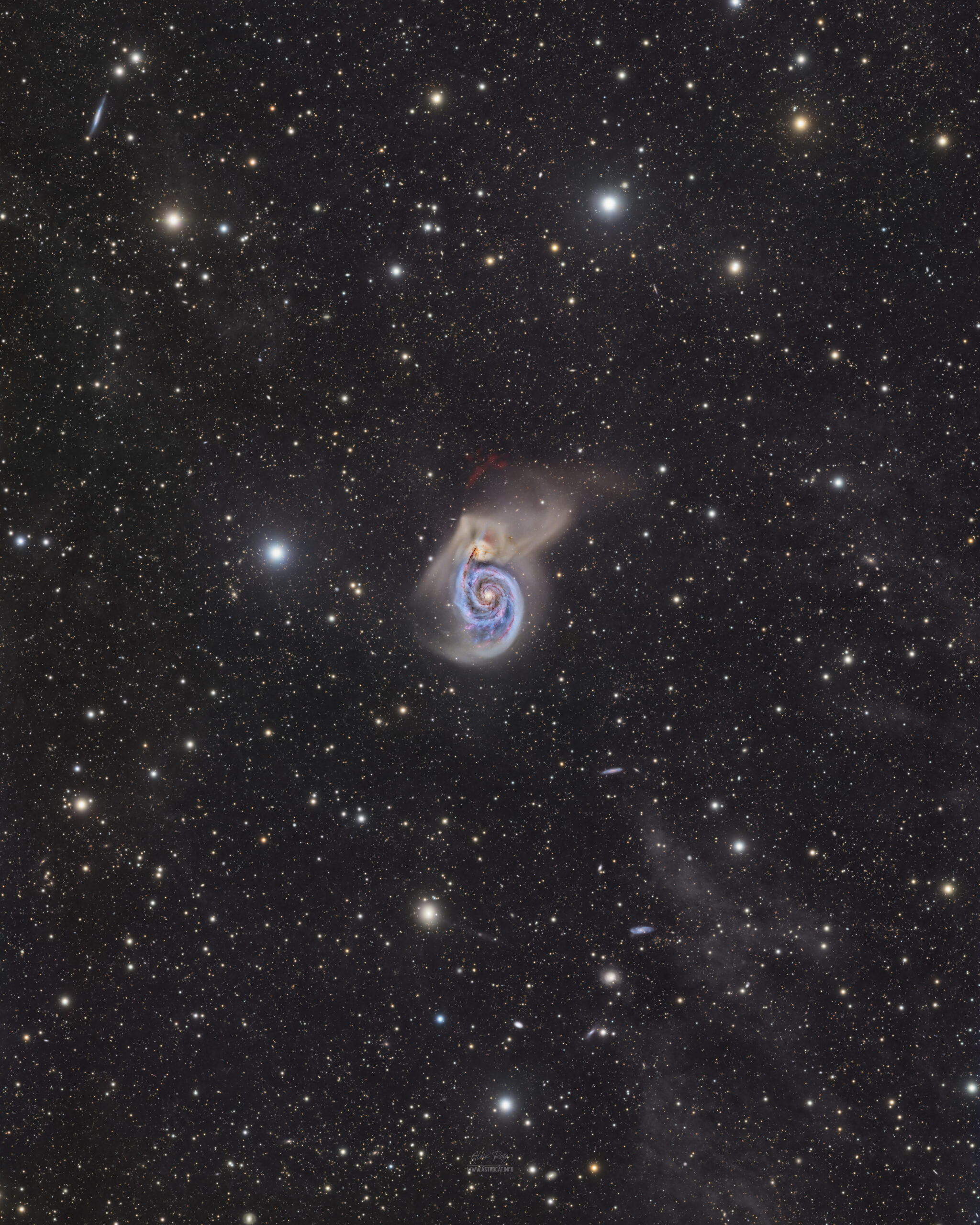
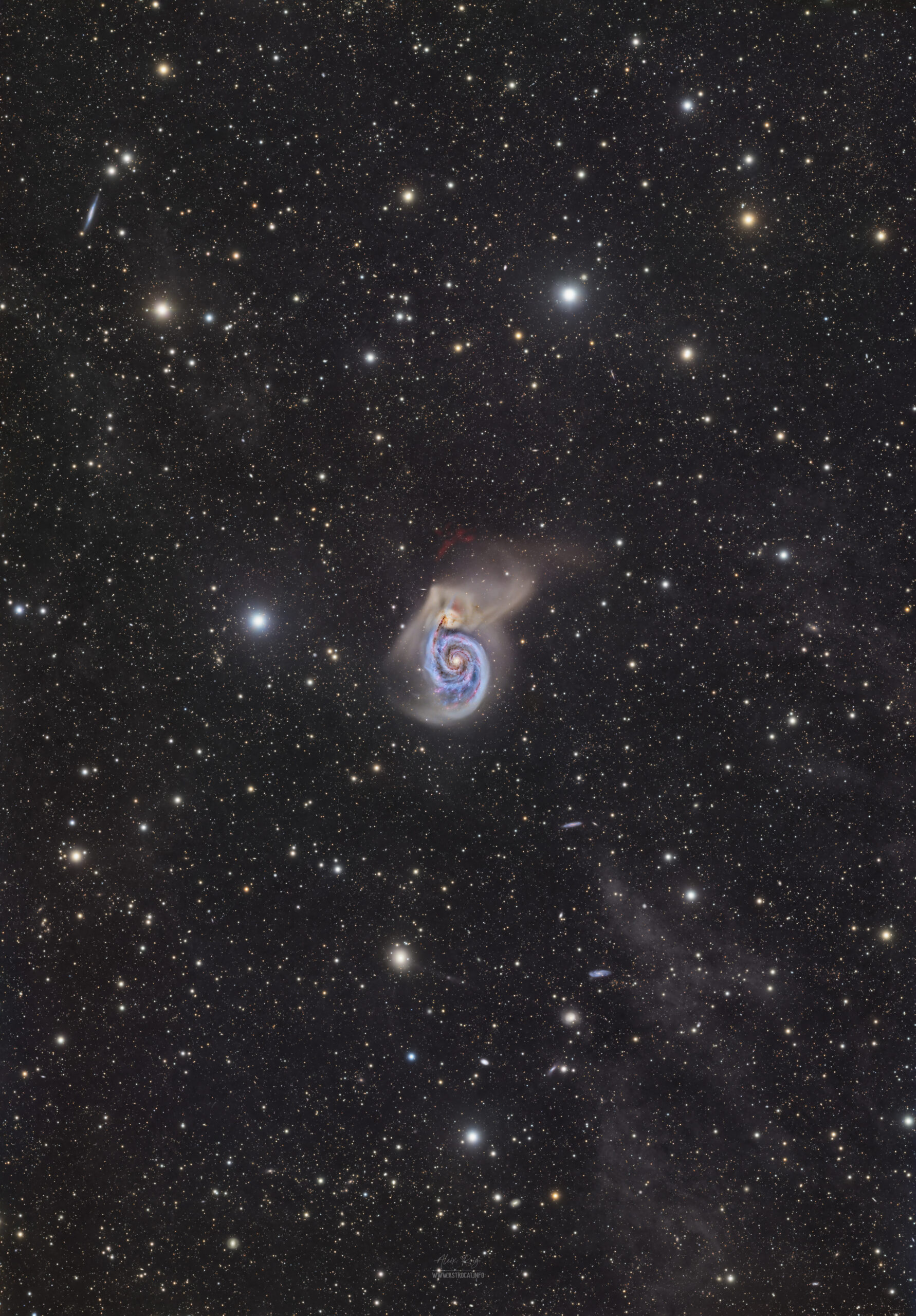
Captured from my backyard observatory in Prades, Spain, the Whirlpool Galaxy (M51) is a classic grand-design spiral galaxy located in the constellation Canes Venatici, at a distance of approximately 23 million light-years. It is gravitationally interacting with its companion NGC 5195, a smaller lenticular galaxy whose tidal influence is responsible for M51’s well-defined spiral arms, prominent dust lanes, and enhanced star formation.
With a physical diameter of about 75,000 light-years, M51 is among the most studied nearby galaxies. Beyond the main interacting pair, the wider field of view reveals extensive tidal streams and stellar debris produced by gravitational interactions among several galaxies in this region. One prominent tidal stream can be seen extending from the galaxy NGC 5198 toward the galaxy NGC 5173, with additional surrounding galaxies such as NGC 5169 and PGC 47274 embedded within the same interacting environment.
Long integrations also reveal extremely faint H-alpha emitting regions, highlighting vast complexes of ionized hydrogen where new stars are being born. These emissions extend well beyond the bright spiral arms, following tidal features and distorted outer structures created by gravitational interactions.
In addition to the extragalactic structures, the image shows a faint Integrated Flux Nebula (IFN) present in this area of the night sky. The IFN is composed of interstellar dust clouds within our own Milky Way, illuminated by the combined light of the Galactic stellar population. Its presence adds an additional foreground layer, enhancing the depth and complexity of the scene.
This image is the result of a total integration time of 119 hours 30 minutes:
• 65h 05m of luminance data captured with the Takahashi FSQ-106EDX4
• 41h 40m captured with the Takahashi FSQ-85ED, enabling the detection of extremely faint H-alpha structures
The data were collected up to April 2024 and intentionally left untouched until now. The final processing was completed in 2026, making this work entirely new, with a fresh and careful interpretation of a deep, long-term dataset.
I hope you enjoy exploring the subtle tidal streams, ionized hydrogen filaments, and the delicate IFN that together reveal the true depth of this rich galactic field.
The full image covers an area of 2º 17′ x 1º 36′ at a resolution of 1.46″/pixel.
Image Details
FSQ106:
L: 781 x 300″ (65h 05′)
FSQ85:
RGB: (45,49,159 x 120″) (12h 45′)
Ha: 500 x 300″ (41h 40′)
Calibrated with darks, flats and dark-flats.
Total exposure: 119h 30′
Moon at 30% (on average)
Image resolution: 1.46”/pixel
FOV (full image): 2º 17′ x 1º 36′
Equipment
FSQ106 EDX4 + ASI2600MM + LRGB Astrodon filters + Ha3nm Antlia – with ZWO EFW 7 pos
FSQ85 + ASI294MM + SHO LRGB Baader filters – with ZWO EFW 8 pos
Mesu200 mount
Guiding with ASI120MM and ZWO Mini Guide Scope
Software
SGP, PHD2, APP, PIX, TPZ, PS.
Aleix Roig, January 2026.
Prades (Tarragona, Catalonia – Spain).