
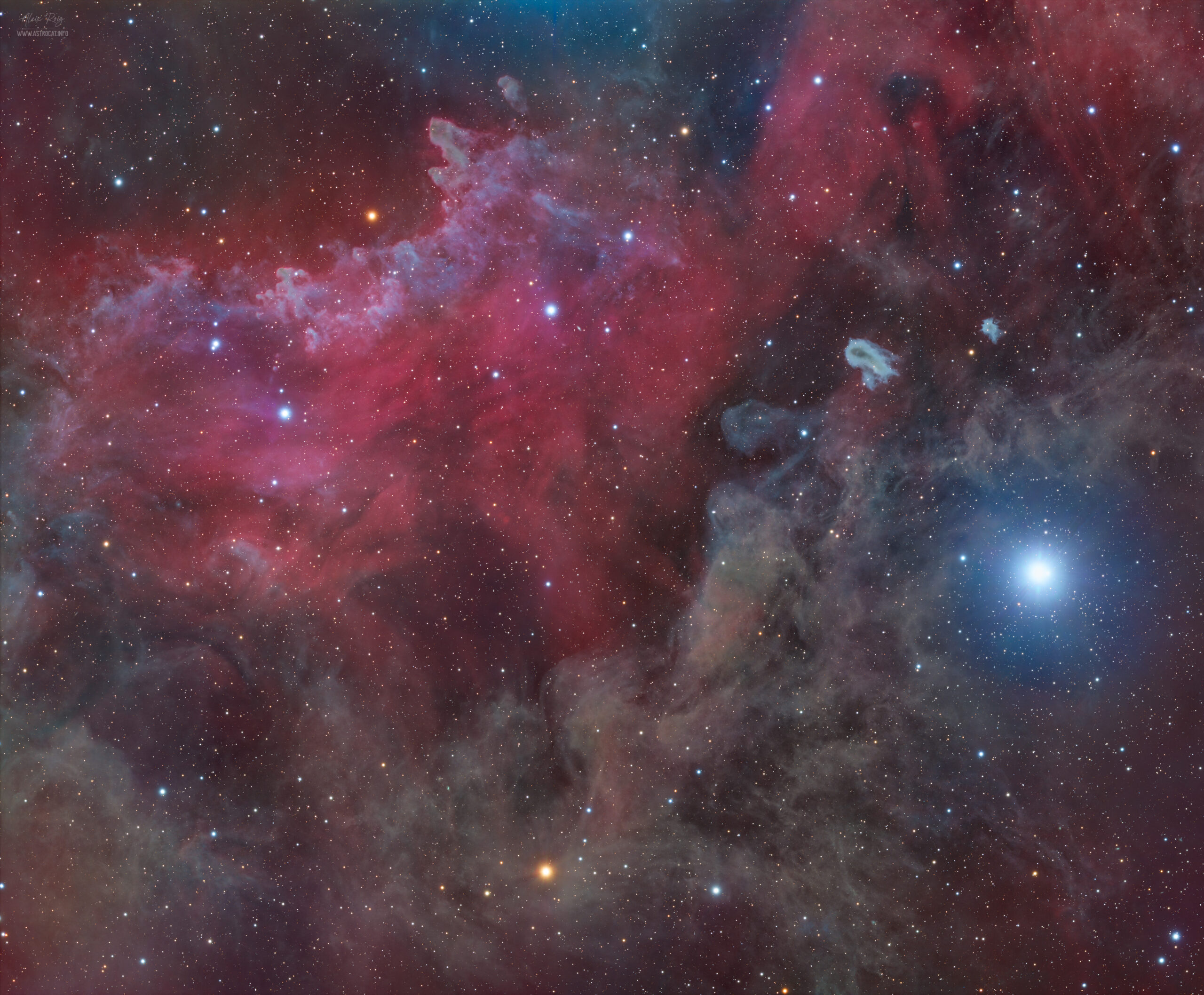
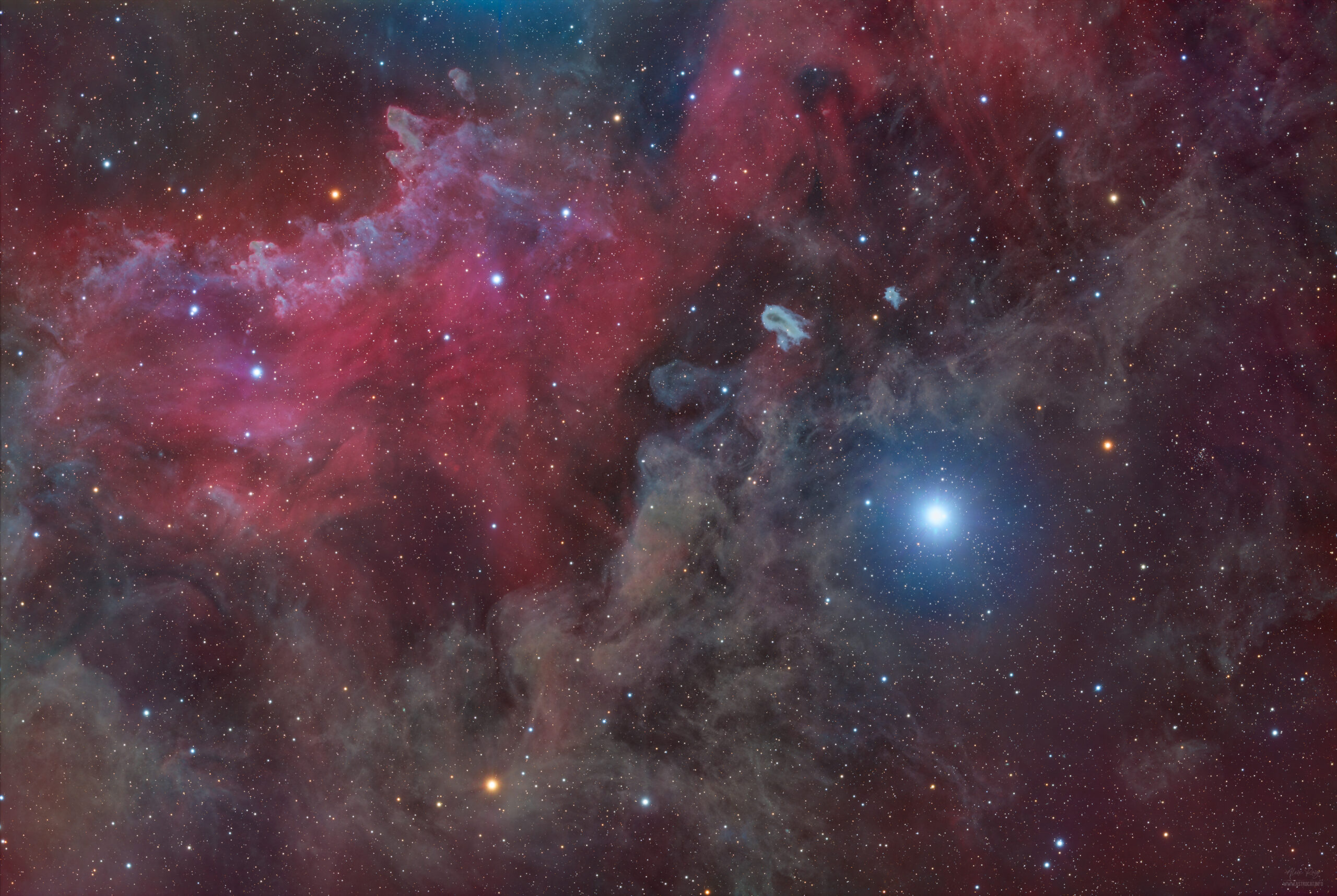
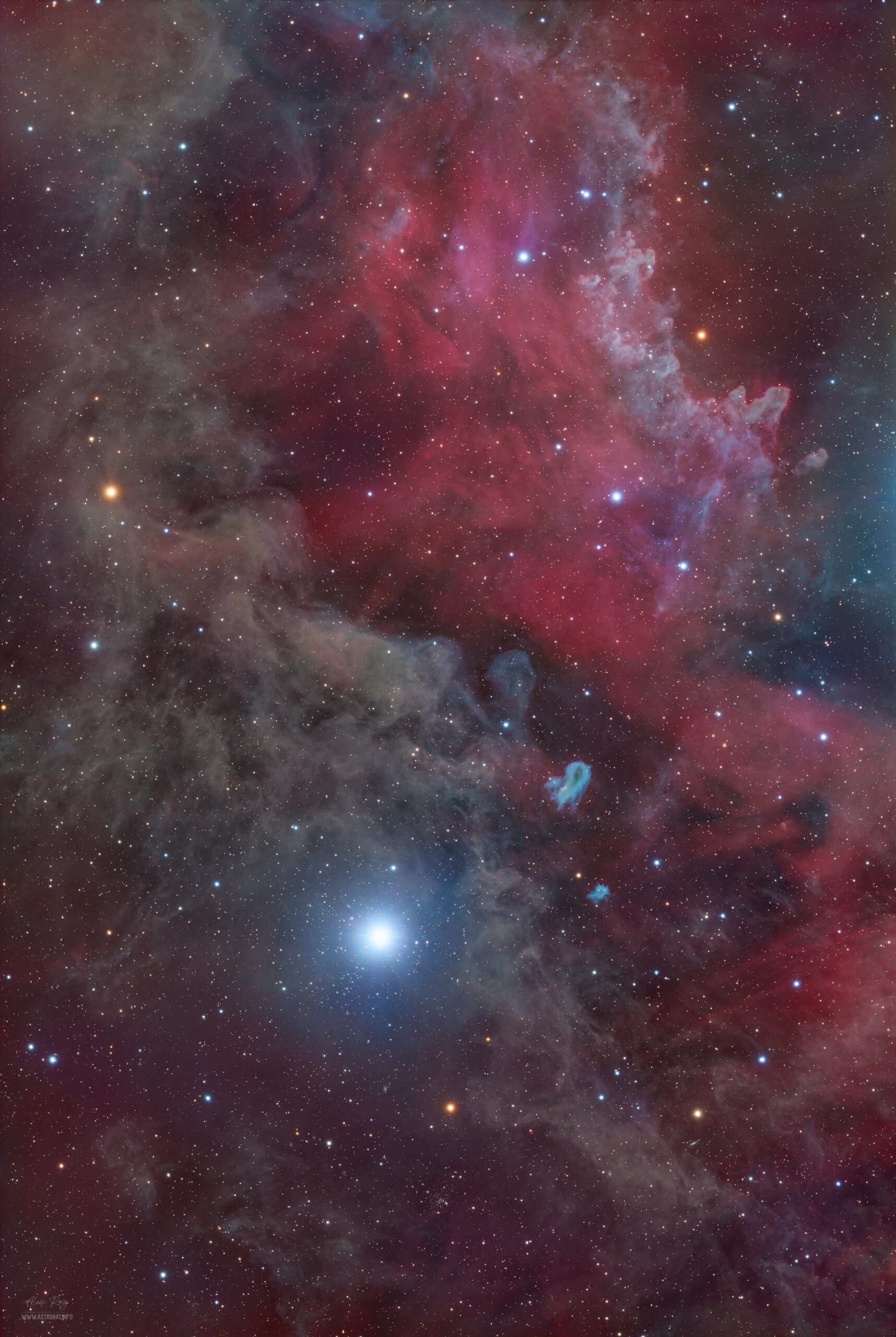
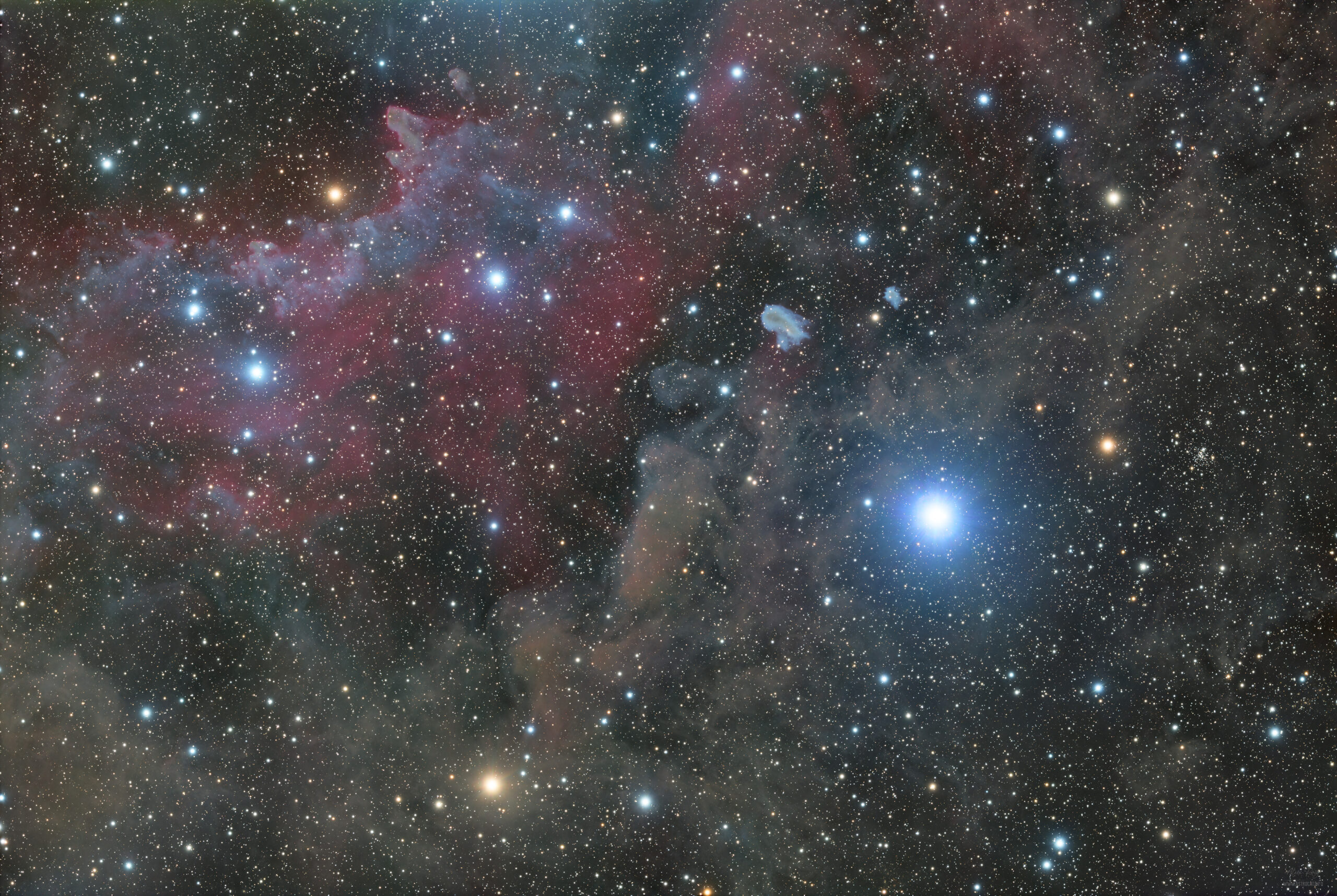
This deep-sky image, captured from Astrocat Observatory, my home observatory, during the last weeks of 2024 and the first days of January 2025, explores the region surrounding Mintaka (δ Orionis), one of the three stars forming Orion’s Belt. Mintaka is a multiple star system dominated by a hot O-type star, located at a distance of approximately 1,200 light-years. Its intense radiation gives the star its characteristic bluish color, clearly visible near the lower right center of the frame. As a massive, young stellar system, Mintaka plays an important role in shaping the local interstellar environment through strong ultraviolet radiation and stellar winds.
Also present in the field is the diffuse glow from Alnilam (ε Orionis), visible toward the upper left portion of the image. Alnilam, an extremely luminous B-type supergiant, contributes additional ionizing radiation to the region, further influencing the surrounding gas and dust.
The image reveals extensive Integrated Flux Nebula (IFN) clouds permeating the field. These faint, filamentary dust structures are not emitting light on their own, but instead reflect and scatter the combined light of the Milky Way’s stellar population. IFN is particularly challenging to capture due to its extremely low surface brightness, making it a subtle but scientifically significant component of the galactic cirrus in this area.
Superimposed on the IFN are traces of ionized gas emissions, most notably hydrogen-alpha (Hα) and doubly ionized oxygen ([O III]). The Hα emission highlights regions where ultraviolet radiation from massive stars ionizes surrounding hydrogen, while the [O III] signal traces higher-energy excitation zones within the interstellar medium. Together, these emissions map the interaction between Orion’s massive stars and the complex structure of gas and dust in this star-forming region.
This field illustrates the dynamic interplay between massive stars, ionized nebulae, and interstellar dust, offering a detailed view into the astrophysical processes shaping one of the most studied regions of the winter sky.
The full image covers an area of 2º 30′ x 1º 41′ at a resolution of 1.46″/pixel.
Image Details
FSQ106:
L: 322 x 300″ (26h 50′)
RGB: (150,171,150 x 120″) (15h 42′)FSQ85:
Ha: 306 x 300″ (25h 30′)
[OIII]: 222 x 300″ (18h 30′)Calibrated with darks, flats and dark-flats.
Total exposure: 86h 32′
Moon at 20% (on average)
Image resolution: 1.46”/pixel
FOV (full image): 2º 30′ x 1º 41′
Equipment
FSQ106 EDX4 + ASI2600MM + LRGB Astrodon filters + Ha3nm Antlia – with ZWO EFW 7 pos
FSQ85 + ASI294MM + SHO LRGB Baader filters – with ZWO EFW 8 pos
Mesu200 mount
Guiding with ASI120MM and ZWO Mini Guide Scope
Software
SGP, PHD2, APP, PIX, TPZ, PS.
Aleix Roig, December 2025
Prades (Tarragona, Catalonia – Spain).