
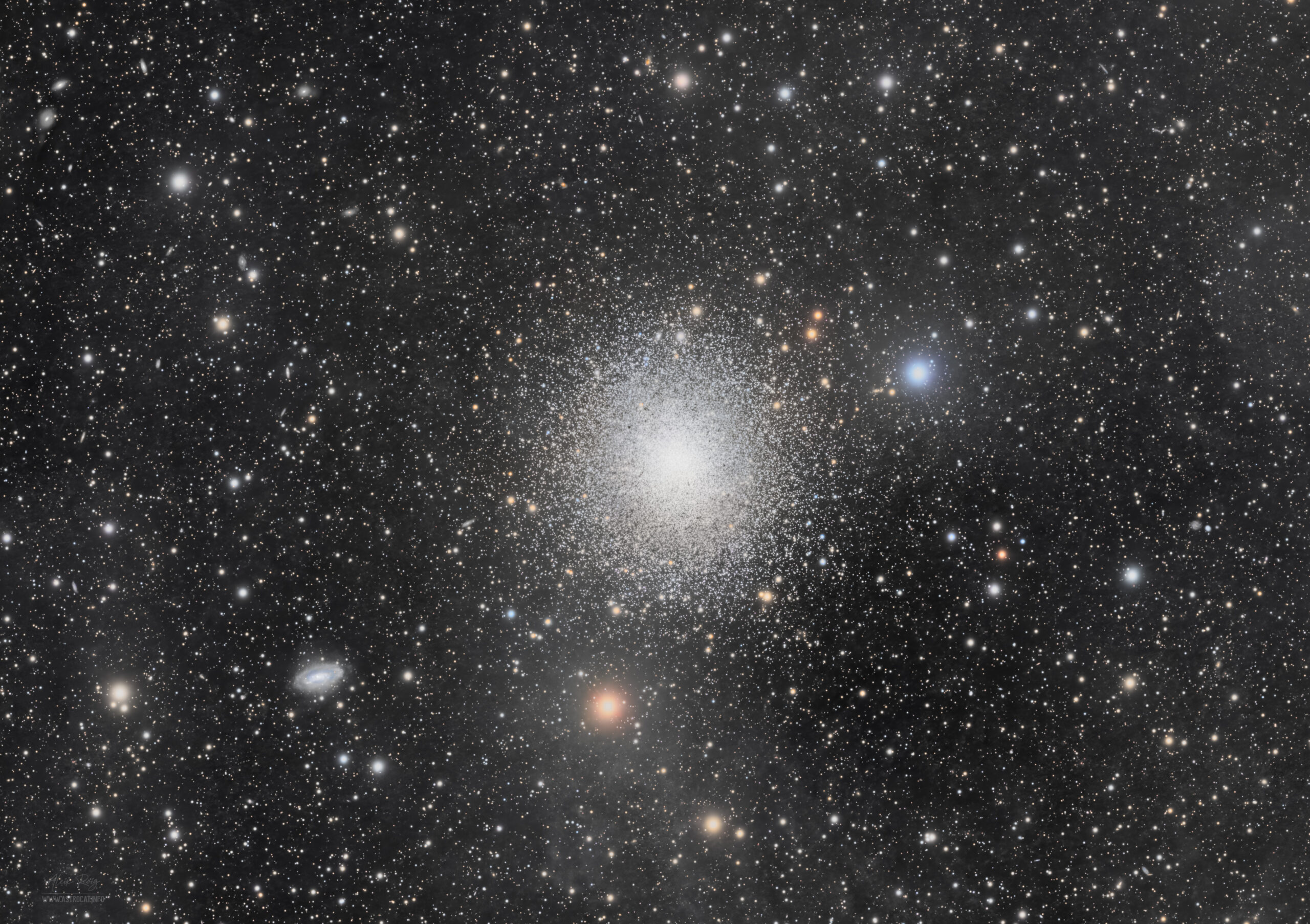
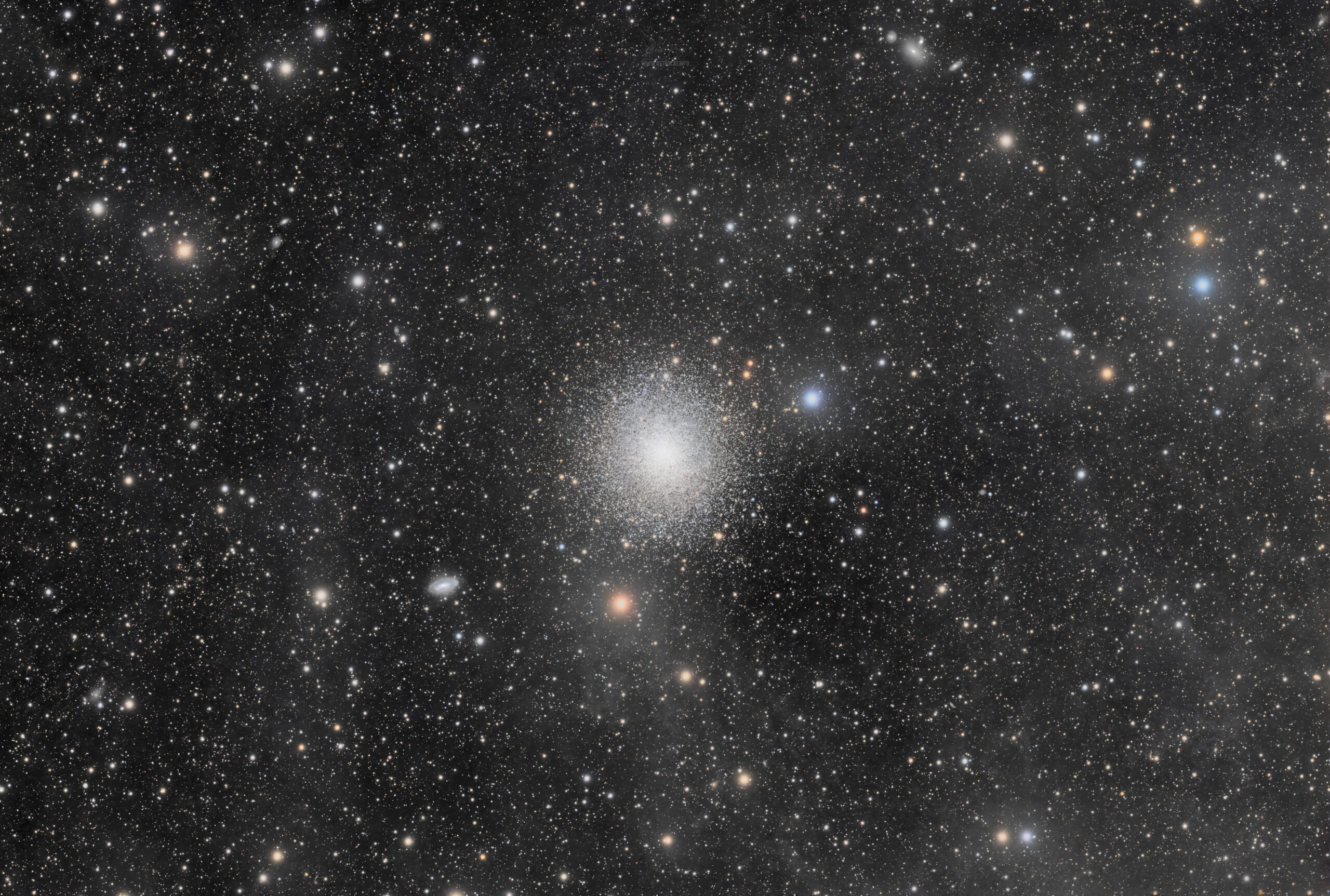
Captured from my backyard observatory in Prades, Catalonia – Spain, the Messier 13 (M13), often called The Great Globular Cluster in Hercules, is one of the most spectacular globular clusters visible from the Northern Hemisphere. Located in the constellation Hercules, it lies approximately 22,200 light-years from Earth and spans about 145 light-years in diameter.
Containing several hundred thousand stars—and possibly over half a million—M13 is a densely packed spherical system bound together by gravity. Its stars are predominantly Population II, ancient and metal-poor, with an estimated age of around 11–12 billion years. Observing M13 is essentially looking back toward the early epochs of our galaxy.
The cluster’s core is extremely dense: stellar separations shrink to fractions of a light-year in the center, compared with several light-years in our local stellar neighborhood. Long-exposure imaging reveals intricate stellar chains, delicate color contrasts, and the granular texture that gives globular clusters their extraordinary sense of depth.
M13 also hosts numerous variable stars, particularly RR Lyrae types, essential standard candles for distance measurements in astronomy.
With nearly 48 hours of total exposure, the image reaches far into the outer halo of the cluster while maintaining structure and control in its intensely crowded core.
A particularly rewarding aspect of this project is the appearance of a faint Integrated Flux Nebula (IFN) surrounding the field. Thanks to the 24 hours of luminance data captured under dark Bortle 4 skies, an extremely subtle galactic cirrus has emerged in the background. These faint dust structures, illuminated by the combined light of the Milky Way, add an additional layer of depth and context to the scene—reminding us that M13 is not isolated in space but seen through the complex interstellar medium of our own galaxy.
Imaging from Prades under stable spring conditions provided the consistency required to resolve the cluster’s dense stellar core. The dual Takahashi FSQ configuration delivered a flat, sharp field across the frame, enabling excellent star definition and deep background extraction while preserving the delicate IFN signal.
Globular clusters like M13 orbit in the halo of the Milky Way and are relics of the galaxy’s earliest formation phases. Each resolved star in this image represents a survivor from a time when the universe was still young.
Beyond its brilliant core, this deep integration reveals the subtle interaction between ancient stellar populations and the faint galactic dust of the Milky Way—combining cosmic archaeology with the delicate structures of interstellar space.
The full image covers an area of 2º 24′ x 1º 37′ at a resolution of 1.46″/pixel.
Image Details
FSQ106:
L: 290 x 300″ (24h 10′)
FSQ85:
RGB: (255,286,173 x 120″) (22h 48′)
Calibrated with darks, flats and dark-flats.
Total exposure: 47h 58′
Moon at 15% (on average)
Image resolution: 1.46”/pixel
FOV (full image): 2º 24′ x 1º 37′
Equipment
FSQ106 EDX4 + ASI2600MM + LRGB Astrodon filters + Ha3nm Antlia – with ZWO EFW 7 pos
FSQ85 + ASI294MM + SHO LRGB Baader filters – with ZWO EFW 8 pos
Mesu200 mount
Guiding with ASI120MM and ZWO Mini Guide Scope
Software
SGP, PHD2, APP, PIX, TPZ, PS.
Aleix Roig, February 2026.
Prades (Tarragona, Catalonia – Spain).